More Than Words
My own declaration of independence didn’t come on a Fourth of July — it came on an ordinary November afternoon
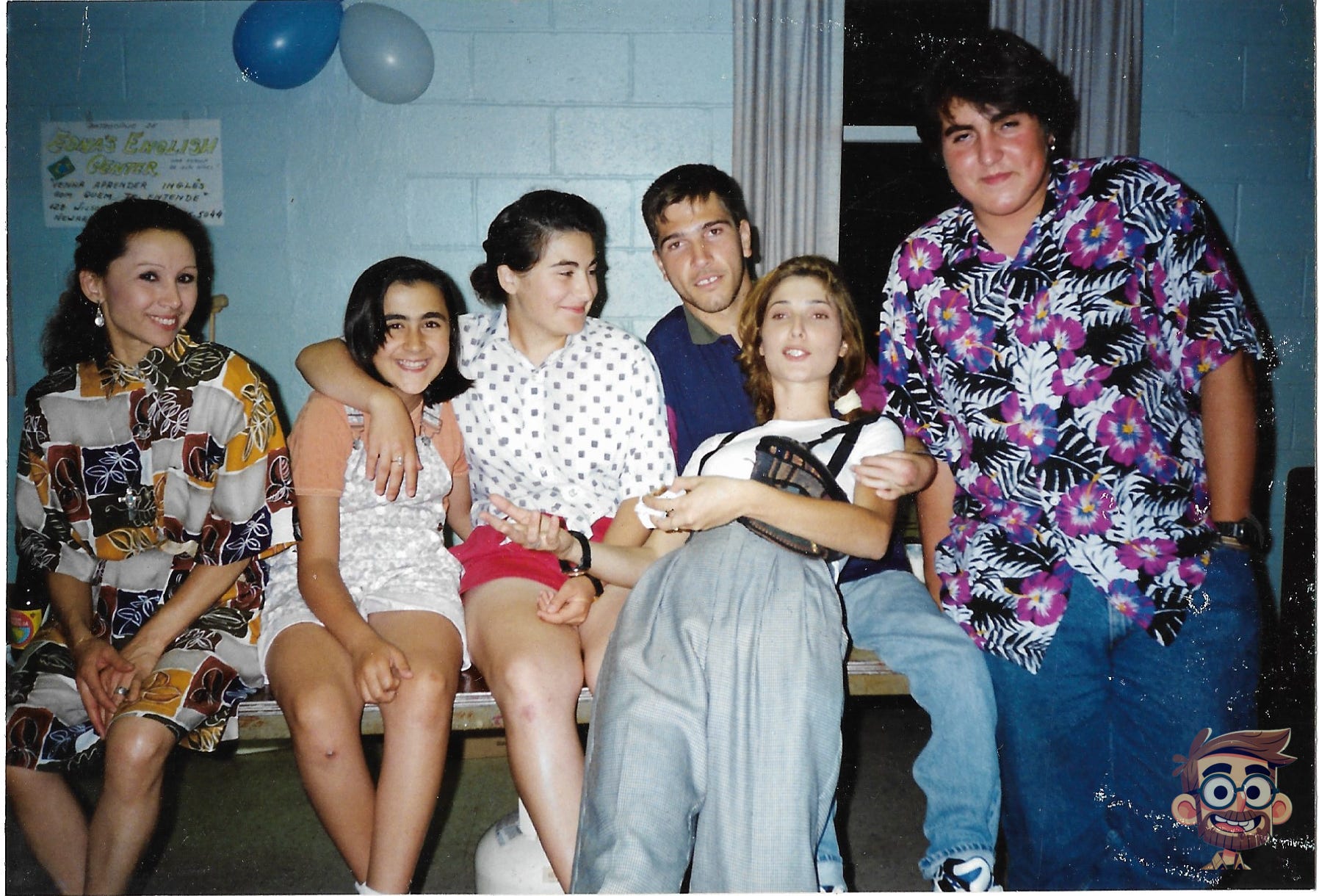
Hanging out with friends of different nationalities (circa 1993)
Now that school is finally over and summer has officially started, my family and I took our yearly trip—almost a tradition by now—of spending the first day of summer at the beach, usually somewhere in North Carolina. Mostly because it’s a short drive from home, and it spares us hours stuck in traffic just to reach a place that’s bound to be crowded anyway.
With all the extra time together lately, I’ve found myself telling old stories—and while my oldest knows these memories well, my 19-year-old seems to have missed a lot of them. The other day, as I was describing something that happened when I was a teenager living in New Jersey, she surprised me: “Wow, what’s with all the lore you’ve been dropping lately?” It still makes me laugh to hear her put it that way.
Every now and then I’ll dredge up something from the past and share it with my kids, for no reason other than to make sure they know a little about me and where I come from, and to pass along a few of the lessons I picked up along the way. But also because I like turning these things over—not dwelling on them, exactly, but remembering them, because I do believe they made me who I am, and shaped the decisions I’ve made since.
So as we drove to the beach, I started reliving some of them. And one that surfaced was the day I realized I could actually understand English. You see, for the first 17 years of my life, English wasn’t part of my world at all—I grew up somewhere else, speaking another language, and when I moved to the U.S. I didn’t know a single word of it. So that realization was no small thing.
It’s funny how your whole world can turn upside down in a matter of hours. I still remember, very clearly, my last days in my home country—leaving with one of my sisters to begin a new journey, on our way to rejoin our parents, whom we hadn’t seen in a month. They’d decided they were done with the complications and financial instability of a country that couldn’t offer them a real chance to provide for their family, or any guarantee of a future for us. So they sold everything they owned and took a one-way trip to the U.S., chasing the American dream. About a month later—after I’d spent all that time looking after my younger sister while my older one finished her schooling in another town—they finally gave us the green light: it was time to join them.
That last night, some of my closest friends threw me a farewell party the best way they knew how: they took me out for drinks. Every so often, one of them would swing by the table, have a drink, wish me luck, and slip off into the night. I can still picture myself at that bar by the beach, telling myself—at only 16—to hold on to all of it, because chances were I’d never come back to that town. Chances were I’d never see those people again. One by one, they came over to hug me and wish me well. And one by one, I watched them walk away—some of them for the last time.
By the end of the night, after far too much to drink, I barely made it back to the hotel. The next day, after goodbyes to relatives, my sister and I climbed into a car with one of my uncles, and 24 hours later we were at the international airport, boarding a plane to New York City.
I arrived in the U.S. on May 28th, 1991, carrying a single piece of luggage, a box of stamps I’d been collecting since I was eight, and one or two books I treasured. I remember meeting my parents at JFK and the flood of relief at being together again, knowing they were okay. That whole month they’d spent getting things ready for us had been full of adventures—and adversities—mostly because they could barely speak the language.
My dad had been promised a job with a company that repaired and repainted bridges—told he could make a ton of money if he teamed up with a guy he’d met briefly the previous summer. Reality looked different. When he got here, the job never materialized, and he had to scramble for anything that would pay the bills and keep the next chapter alive. Through some fellow expats, he landed work as a pizza delivery guy—a position that wasn’t given to him so much as sold to him, for a very hefty sum.
It’s a strange thing to sit with, and something many people may not realize: so many of the immigrants I knew who came here looking for work—unable to speak the language, unfamiliar with the culture, unsure how anything worked—felt they had no choice but to lean on those who already knew the ropes. And too often, the ones who knew the language and had been here longer would pretend they could line up a position for a newcomer, at a price: the newcomer had to hand over several months’ worth of whatever that job paid. So my parents both, quite literally, bought the chance to work.
With the painting job gone, my father—a forest engineer by training—became a pizza, and later a bread, delivery guy. My mother, a teacher, took work as a cleaning lady. Neither spoke much English. But necessity is the mother of invention, and my parents, true to the hardworking immigrant who’ll do anything and stop at nothing to make the best of a hard situation, simply rolled up their sleeves and got to it.
So there I was at JFK, astounded by how different everything was from back home. One of the first images that stuck with me, even after all these years—and it’ll sound silly to anyone reading this today—came when I used the airport bathroom before we drove back to New Jersey: the toilet flushed by itself. I know how that sounds, but I was genuinely amazed at how advanced this new world seemed.
We piled into an old Buick my dad had also bought from someone—part of the same package as the delivery job—and drove to a place in northern New Jersey. For the time being, the four of us—my parents, my younger sister, and I—shared a single room in a two-bedroom apartment, and that’s how we lived for the next month and a half. Eventually they saved enough for a place of our own, and we moved out just in time for high school to begin—and just in time for my oldest sister to finish her studies and join us here.
We’d arrived in late May, and for the first two months of summer, my mother enrolled me in an English class for speakers of my language. Three times a week, I walked from our apartment to the school and sat shoulder to shoulder with people much older than me, all of us trying to learn this language and find our footing in this country. By September, I’d picked up just enough English to start high school.
There were stretches when I struggled—homesick, missing my friends, forever wondering what they were doing and what I was missing. Sixteen on the edge of seventeen, dropped into a brand-new world, unable to talk to anyone because I couldn’t speak the language, with no kids my age who spoke my own—it was genuinely traumatic. Every day I wrote letters home, pouring out how much I missed everyone and how much I envied that they were still there and I wasn’t. In July alone I must have written over a hundred. But a letter took seven days to arrive and another week to come back—if it came back right away at all—and as the summer wore on and the replies thinned out, I decided it was time to move forward instead of staying stuck in the past.
My first day of high school was a nightmare. I was blindsided by the crowds of English speakers who knew exactly how it all worked—the schedule, where to go, when to go—while I was hopelessly lost. The guidance counselor assigned to me eventually tracked down a girl who spoke my language and who, reluctantly, acted as my translator for the first couple of days. But she didn’t want anyone knowing she spoke another language; she was busy acclimating, trying not to stand out as different.
I remember walking into the cafeteria that first day with no idea what to do or where to sit. Then, with a wave of relief, I spotted my translator at one of the tables. I made my way over feeling like I’d found a sanctuary, however brief—only to be told I couldn’t sit there, because every seat around her was already spoken for. So I took a table in the corner, alone, and that’s where I spent my first three months of high school.
It’s amazing how fast you can adjust to a new environment, and how adversities—or things that only feel like adversities—settle into routine after a while, especially when you’re young and stubborn about getting through them. By the middle of November or so, already living in the new apartment, I’d gotten used to the rhythm of school, the shuffle between classes, the constant wash of English around me, 24/7. Every time I turned on the TV, it was something in English—a basketball game, a baseball game, MTV, VH1. And all day at school, my teachers and classmates filled the air with it.
I suppose it was only a matter of time before something clicked, and for me, the moment came while I sat in my room doing geometry homework with the radio on—Z100, like always. A song that had been playing several times a day on MTV came on, and I started humming along while my mind churned through my homework. Since I’d never learned any of this geometry in my native language, I was silently repeating the terms my teacher had used to explain it—all of it in English. And as the song played, and I hummed, and my brain juggled the two at once, I started, without noticing, singing along to the lyrics. Then it stopped me cold: I wasn’t just singing in English—I understood every single word. That was the moment I knew I’d fully crossed over, that I could tell anyone, truthfully, that I understood English.
The song, fittingly enough, was “More Than Words.” And to this day, every time I hear it, it carries me back to that teenager in the fall of his junior year, bent over his geometry homework, realizing he’d finally learned just enough English to be dangerous. It would take me years more to catch the finer nuances of the language, and longer still to absorb the cultural things—about the language and about the country itself. But “More Than Words” will always belong to the day I stopped being an immigrant living in the past, aching for everything I thought I was missing and everyone I’d left behind, and started becoming a citizen of this new country—fully committed to learning its history, its culture, and to making it home.