The Week the Mill Ran Ahead of Its Keepers
When the machine moved faster than the people around it
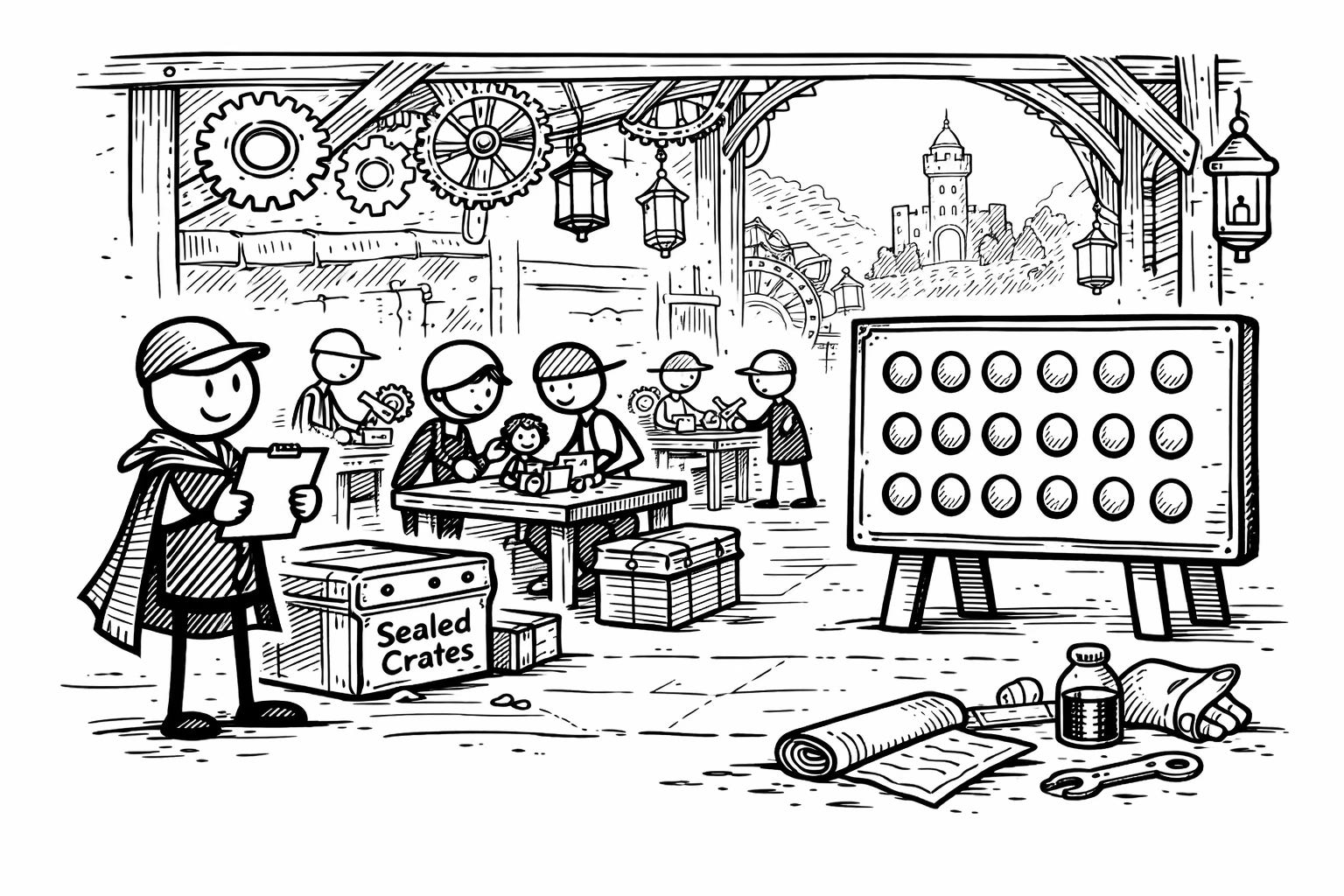
Illustration generated using AI image tools, prompted and directed by the author.
The week began with movement that led nowhere.
The belts turned.
The gears engaged.
Yet nothing new would hold.
Not in the dramatic way the tower liked to describe in meetings, but in the quieter way machinery sometimes resists—belts turning without carrying anything forward, gears waiting for instructions that never arrived. The conveyors that fed the Night Lantern Circuit refused to accept new patterns, leaving both the working mill and the frozen winter frame standing still.
Apprentice Methodius studied the problem first.
“The belts should regenerate their markings,” he said, tracing the diagrams with a careful finger. “But they do not. Either the fault is shared across the estate… or we are alone in it.”
Signalwright crossed his arms. “If we’re alone, we fix it. If everyone’s stuck, we wait. Either way, we need answers.”
And so Methodius began asking beyond the mill walls, searching to see whether neighboring mills faced the same frozen machinery.
Elsewhere, another frustration spread quietly among the craftspeople. Master Bridgehand and Signalwright found themselves unable to assemble the practice rigs needed to test new mechanisms. Parts that should have fit together refused to align.
Forge-Bearer Swiftroot listened, then shrugged lightly.
“I built mine with a different set of tools,” he said. “Come tomorrow. We’ll assemble yours together.”
No fanfare. Just an invitation.
By morning, the practice rigs stood working.
The Watchful Cogs continued their slow awakening.
They had begun catching faults before lantern-bearers ever reached them, revealing cracks and regressions that once would have slipped unnoticed into production. Yet everyone knew the truth: the mill still relied on manual inspection for the final blessing.
On the next day, Methodius called the craftspeople together in the archive hall.
“Interface trials are stable,” he said. “Existing mechanisms are holding. Upgrade paths are underway.”
Forge-Bearer Swiftroot nodded once—his silent confirmation that progress was real.
But the hardest work remained: Testing the engine under shifting conditions.
“This needs a swarm,” Signalwright said.
The work moved from Master Bridgehand to Apprentice Methodius, acknowledging the priority of the Conversing Engine above all else.
Soon they discovered the truth.
The current weave of the Convergence Loom could not handle shifting patterns.
A separate pipeline would be required.
A new lane built beside the old one.
Not ideal but necessary.
Midweek, the Steward watched the tower’s windows open more frequently.
Questions arrived with increasing urgency.
How soon?
How stable?
How many lanterns are green?
The Steward answered calmly, though fatigue lingered behind his eyes.
Behind the scenes, he carried crates no one else saw—security inspections, vulnerability repairs, explanations delivered upward so the tower would not pull more craftspeople away to aid the struggling Crucible mills. Rumors drifted through the estate that those mills were behind schedule, that reinforcements would soon be demanded.
For now, the Steward held the line.
The wolves circled.
The mill kept working.
The week pressed on.
The Watchful Cogs reported failures. Then successes. Then failures again.
One stubborn section remained red, blocked not by flaw but by timing; a necessary change could not yet be promoted while other mills approved the current shipment.
So they waited until clearance for their change was approved.. Patience, for once, became part of the work.
“This is it,” Methodius said as he applied the last change to the testing environment.
“Will the lanterns turn green this time,” the Steward asked trying not to show his exhaustion.
The answer came faster and with more conviction than was customary from Apprentice Methodius: “I guarantee it.”
Meanwhile, the tower shifted the estate itself.
New mills were rumored to be forming—vast operations dedicated to new forms of craft. Entire teams had already been moved. Signalwright found himself staring toward the distant construction more than once, eyes narrowed as if measuring something only he could see.
The Steward noticed.
He said nothing.
The weekend arrived quietly.
The mill was empty.
The craftspeople resting.
Only the Steward walked the floor.
He checked the Watchful Cogs.
The Illuminated Board.
And stopped.
All tests green.
All vulnerabilities addressed.
The shipment date still weeks away.
For the first time in memory, the mill was ahead.
He stood there longer than he meant to.
Proud.
Exhausted.
Uncertain whether to trust the feeling.
Next week, he decided, they would run a full simulation.
Tag every component.
Seal every Crate.
Let the Watchful Cogs judge the work as if the shipment day had already arrived.
Because when a mill finally runs ahead of schedule… you don’t relax.
You test it harder.
And somewhere above, the tower continued reshaping the estate—new organizations forming, old ones dissolving, craftspeople reassigned like pieces on a board.
The mill was steady.
The future was not.
And the Steward suspected that stability itself might soon attract attention.
Any resemblance to real mills, past or present, is entirely coincidental—and probably unavoidable.