The Week the Lanterns Turned Green
Progress, pressure, and the quiet sound of the estate shifting
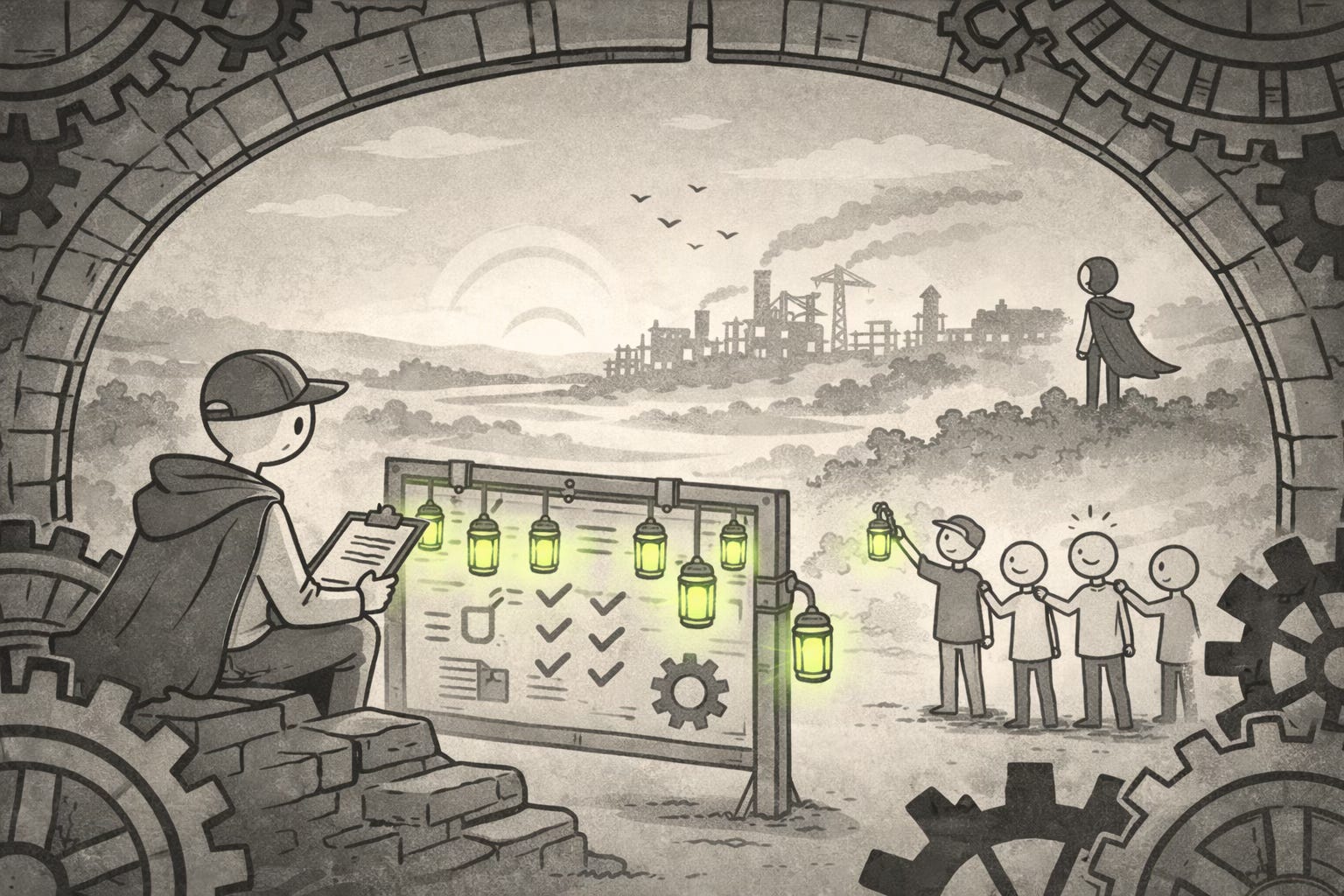
Illustration generated using AI image tools, prompted and directed by the author.
The week began with a gate.
Not a physical one, but an old checkpoint buried deep in the mill’s machinery—one that no other neighboring mill required, yet one that had once been implemented at this mill to halt carts for reasons few remembered.
Apprentice Methodius stood before the team, his diagrams spread across the workbench.
“The reason our tests are not running properly is because of this gate,” he pointed at the diagram with emphasis. “This gate is stopping the Watchful Cogs,” he said carefully. “If we remove it, ALL of our tests can pass freely. It’s a small change with a high return of investment. We lose little and gain speed.”
The Reluctant Steward listened, weighing the risk against the momentum already building.
“I trust you. Remove it,” he said, patting Apprentice Methodius on the back. “If it clears the path, we can move forward with the plan.”
Methodius nodded. His voice was quiet, but his certainty held.
When Master Gatewright—the keeper of customer expectations and practical outcomes—returned to the mill the following day, Methodius explained the change in deliberate detail. Gatewright listened, brow furrowed, asking questions not about the mechanism itself but about its consequence.
“Will the merchants be safer?” he asked.
“Yes,” Methodius replied. “And the mill will move faster.”
Gatewright considered this, then smiled faintly.
“Then the investment is worth it. I’ll talk to the merchants set the expectations.”
The work continued.
But elsewhere, another burden fell.
Master Quivver, the expert on all things machinery related, was away from the mill to enjoy a well-deserved break after many heroic nights, and several old toolsets across different production lines were nearing obsolescence. Without them, the Watchful Cogs would stall before they could even begin their nightly work.
The Steward knew that everyone else was already stretched too thin and he couldn’t afford to stop the Plan to assign these repairs to someone else. He rolled up his sleeves and took the tasks himself.
He worked through the day, then through the evening, moving between lines that behaved differently, each requiring manual adjustments no one had written down clearly. One change led to another. One fix exposed a missing piece. The work felt like threading a needle while the loom shifted beneath him.
By the time the lanterns dimmed, most of the refitting was done—but two stubborn problems remained.
He left messages for Forge-Bearer Swiftroot and Apprentice Methodius before finally stepping away. “I did all I could to update our old toolsets, but I need your assistance with these last ones. I feel that you’ve handled them before so you might have a suggestion that can help unblock me by the time I check in tomorrow.”
When morning came, the tasks were resolved.
Swiftroot had solved one with characteristic efficiency. Methodius had unraveled the other through careful experimentation.
Together, the lines moved again.
More tasks closed. More gears aligned.
Young Tallier and Scholar Driftwise added their own pieces to the growing system. The tally of completed work climbed steadily, though the Watchful Cogs could not yet fully run until the refitting was complete.
The Steward watched the numbers rise and nudged Methodius gently.
“You should show this to the estate’s people at the Tower,” he said. “They understand pictures better than ledgers.”
Methodius hesitated, then agreed.
Later that day, the craftspeople stood before the wider estate and showed their progress. Scholar Driftwise spoke thoughtfully about new creations still forming. Methodius spoke about automation, pointing to clear lines and simple graphs.
The response was warmer than expected.
For a moment, the mill felt seen for its progress rather than its struggles.
Thursday brought planning.
The craftspeople gathered around the Illuminated Board as the Steward guided the discussion.
“These are the priorities,” he said calmly. “Automation remains central. Without it, everything else slows.”
Tasks were weighed, debated, moved.
Then Signalwright spoke.
His voice carried easily.
“Some of these automation tasks should wait,” he said, gesturing toward Methodius’s section of the board. “We should start building new features now. The estate is asking for them.”
Methodius straightened.
“If we postpone these,” he said carefully, “the foundation remains unstable. We’ll just repeat the same problems later.”
Signalwright shook his head. “The tower won’t wait forever.”
“And the machine won’t survive shortcuts,” Methodius replied, quieter but firm.
The room grew still.
Signalwright’s presence was strong, confident. Methodius’s words were softer, but they held their ground.
The Steward watched the two forces pull in opposite directions—momentum against foundation.
He raised a hand.
“We are not deciding this in haste,” he said. “Finish planning today and keep the plan moving forward. We’ll return to this together next week and commit to a decision about these other tasks as a team.”
The tension eased, not resolved but contained.
The work moved forward.
To keep the focus on automation, the Steward quietly took on a mountain of security validations himself—work that would otherwise pull others away from the effort. No one argued. They simply returned to their tasks.
That evening, the daily report arrived.
Every lantern burned green.
The mill paused.
No cheering, just quiet satisfaction.
The Watchful Cogs had run through the night without failure.
A step closer.
Before leaving for the recharge day, the Steward gathered Methodius and the others.
“Monday morning,” he said. “Run the automation against every version we still care about. We decide next week whether the release moves forward.”
They nodded.
The plan felt real now.
And yet, beyond the mill, the estate shifted.
Rumors traveled faster than carts.
New workshops were being formed. Entire teams reassigned under new banners. Some mills had already disappeared into larger structures overnight.
Signalwright lingered longer than usual near the doorway, watching the road that led toward distant construction.
The Steward noticed but said nothing.
He had learned that stability often arrived just before change.
Inside the mill, the lanterns glowed steady and green.
Outside, lights in the tower burned late into the night.
And though the machine was finally learning to run on its own, no one could say with certainty who would still be here to watch it when the next week began.
Any resemblance to real mills, past or present, is entirely coincidental—and probably unavoidable.