The Week the Mill Began Watching Itself
When the Mill Learned to Watch Itself
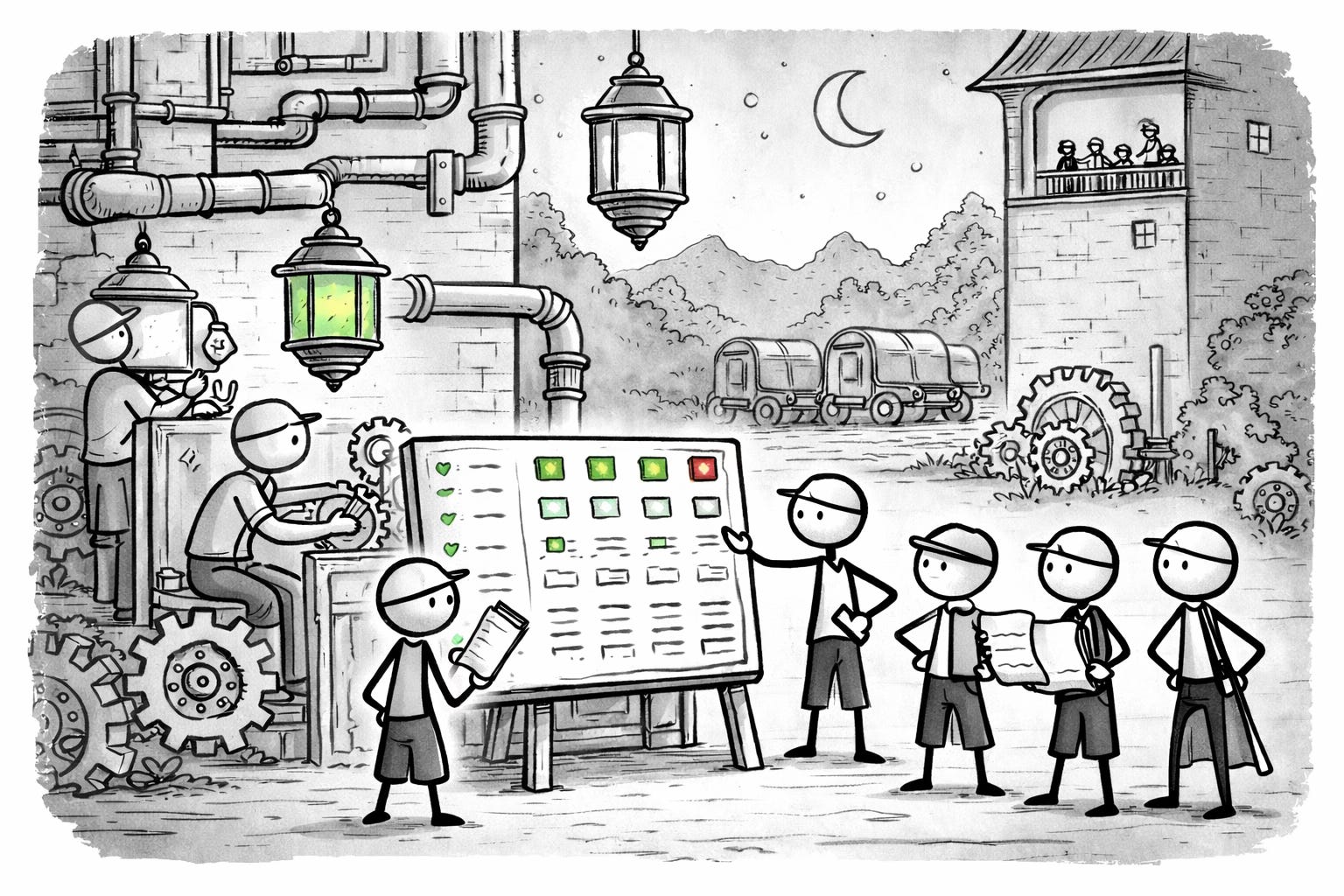
Illustration generated using AI image tools, prompted and directed by the author.
The inflection point arrived sooner than anyone expected.
The tower had spoken of automation as an expectation. The mill, quietly and without ceremony, chose to treat it as an opportunity.
The plan was no longer ink on a map. It was motion.
The mill would no longer rely solely on lantern-bearing craftspeople walking its floors by hand to detect issues or anomalies. It would learn, if possible, to inspect itself.
That required a connection the mill had never fully established before: a line into the Estate’s Night Lantern Circuit—the great system that ran through neighboring mills, reporting each dawn whether machinery had turned cleanly through the night, and whether the goods produced met expectation.
“You cannot inspect what does not report,” Apprentice Methodius said, studying the diagrams with unusual intensity.
“Then we must speak with the Keeper of the Lantern Circuit,” replied the Reluctant Steward.
And so they did.
Master Valvewright—keeper of pipes, valves, and the quiet intelligence of the estate’s nightly signals—received them without ceremony. His work belonged neither to the tower nor to any one mill. He understood connections.
“What you’re asking,” Valvewright said, “is not difficult. But it must be done properly. Once you tie into the circuit, your mill will be judged every night. A green lantern means the gears turned cleanly. A red lantern means something failed. Are you ready to see red if it appears?”
“That,” said Methodius, “is precisely the point.”
There followed a healthy negotiation of timing and priority. Valvewright had other mills requesting adjustments. The estate was rarely short of urgency. Still, by the end of the week, he committed to the work.
By Monday afternoon, the mill was connected.
And with that connection came the Watchful Cogs—newly forged inspection gears placed alongside the existing machinery. They would run each night, testing latches, hinges, and guards automatically, reporting their findings to the Lantern Circuit before dawn.
By Tuesday morning, Apprentice Methodius arrived before anyone else.
“The Watchful Cogs have already uncovered something,” he announced, barely containing his excitement. “A latch we removed in haste last winter was never restored to the main frame.”
Mistress Steadwill paused her threadwork. Master Quivver leaned closer. Silent Measure simply nodded.
The machine, it seemed, had remembered what the craftspeople had nearly forgotten.
Above them, windows in the tower opened.
“How soon until the lanterns all burn green?” a voice asked that afternoon.
“We are still tuning the Watchful Cogs,” the Steward replied. “But they are already proving useful.”
The voice did not sound satisfied. It rarely did.
Then came the Merchant Fire.
A caravan stalled at the estate gates. A configuration never before attempted. A path the mill had not tested.
Signalwright and Scholar Driftwise left at once to investigate. The issue was not catastrophic—but it was illuminating. The path had existed. It had simply never been walked under scrutiny.
“If the Watchful Cogs had been in place sooner,” Master Quivver murmured quietly, “we might have seen this.”
“Then let us be grateful they are here now,” said Silent Measure.
The tower windows opened wider.
The inquiries grew sharper.
“How many lanterns are green?”
“How many remain red?”
“Is the baseline stable?”
Midweek, another suggestion descended from above.
“While you are strengthening the circuit,” came the tower’s voice, “surely this additional matter can be addressed immediately.”
The request was not unreasonable. It rarely was. It was simply mistimed.
Apprentice Methodius hesitated. For all his structure and planning, he was still new to standing firm.
He sought the Steward.
“If we divert now,” he said carefully, “we risk layering new work on unstable ground.”
The Steward nodded.
“Finish the foundation first,” he said plainly. “Then we add anything else. Tell them that.”
And so Methodius did.
No further pressure followed.
Meanwhile, elsewhere in the mill, Journeyman Wayward appeared one afternoon wiping oil from his hands.
“Oh,” he said casually, “I shortened the main axle by three turns. The build cycle runs nearly twice as fast now.”
There was silence.
“Does it?” asked Master Bridgehand carefully.
“It does,” Wayward replied, already drifting away.
The Steward watched the gears spin.
Faster.
Quieter.
He hoped—deeply—that this particular brilliance would not demand a reckoning later.
“Document it,” he said gently.
By Thursday, the map the Steward had once drawn had evolved into something larger: an Illuminated Board mounted near the mill floor. Tasks moved across its surface in clean, visible lines. Each cog, latch, and guardrail accounted for. Iteration One: nearly complete.
The tower studied the Board frequently now.
Curiously, it seemed to trust what it could see.
By Friday, most lanterns burned green—signaling clean turns and stable outputs.
One remained stubbornly red.
It belonged to a section of older machinery—legacy work few had touched in years.
Methodius paced.
“I have tried three approaches,” he admitted. “None are elegant.”
“Have you asked Swiftroot?” the Steward suggested.
Within hours, Methodius returned—not alone, but with a refined approach that unlocked not only his own red lantern, but two others as well.
The Watchful Cogs adjusted.
The Board updated.
The lantern turned green.
For two nights in a row, the lanterns burned mostly green.
The Watchful Cogs had proven capable.
They had not yet been tested under true pressure.
Forge-Bearer Swiftroot and the Steward worked late preparing the release for the coming week, juggling tasks that still required steady hands. Master Bridgehand and Young Tallier continued strengthening the test suites. Silent Measure refined dependencies. Master Quivver prepared to rejoin the effort once his unrelated reforging was complete.
The mill did not yet run flawlessly.
But it had begun, at last, to watch itself.
Next week, for the first time, the craftspeople would attempt something they had never done before:
To release their goods guided not by lantern-bearing hands… but by the machine itself.
And this time, the caravan would already be waiting at the gates.
Any resemblance to real mills, past or present, is entirely coincidental—and probably unavoidable.