The Mandate and the Mill
(A parable, or so I’m told)
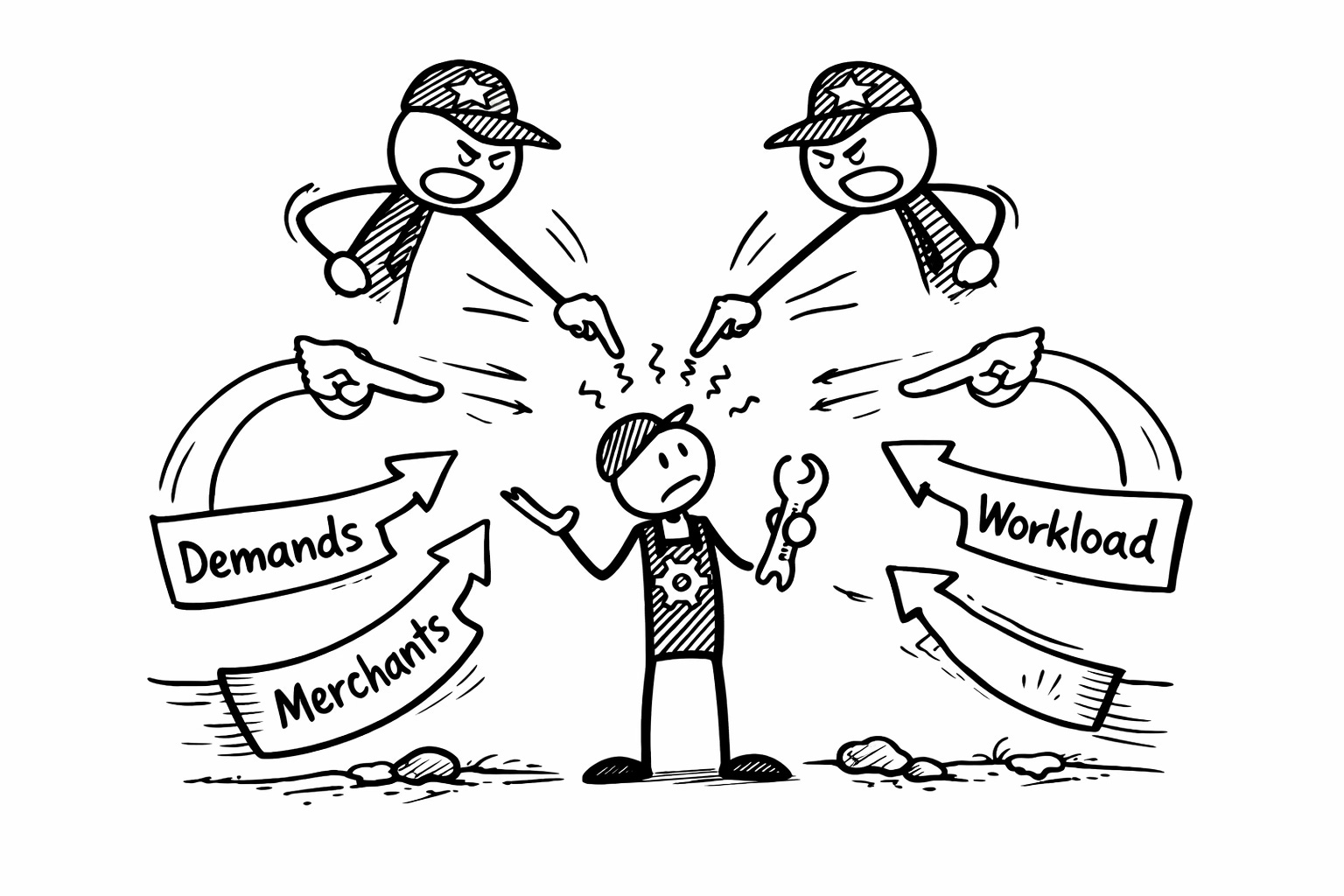
Illustration generated using AI image tools, prompted and directed by the author.
In a large mill at the edge of a sprawling estate, a group of craftspeople worked tirelessly to refine a machine they had spent years building. The mill was not flashy, but it was essential to the estate’s economic health and well-being. It produced reliable goods, shipped on a predictable cadence, and—most importantly—could be trusted not to fail when demand surged.
The craftspeople knew the machine well. They knew where it creaked, where it required manual adjustments, and where a single forgotten step could bring the whole operation to a halt.
Long before any failures occurred, they warned the estate that the mill’s continued reliability depended on steady investment in its inner workings. They drew up careful plans to reinforce its foundations, automate its weakest points, and reduce the need for constant human intervention.
Those plans were acknowledged, politely received, and then quietly set aside as other priorities took precedence.
Then, one summer, a decree arrived from the estate’s highest tower.
The mill, they were told, would now produce a marvel.
Not because the mill was ready.
Not because customers had asked for it.
But because the estate needed something dazzling—something to prove it was still innovative, still relevant, still ahead.
The craftspeople were given three months.
By the time the decree reached the mill floor, less than that remained.
The criteria for the marvel were vague, imagined far from the noise and heat of the mill itself. But the message was unmistakable: nothing else mattered. All other work stopped. Reinforcements were postponed. Weak points ignored. The craftspeople turned their full attention to the marvel.
And—against the odds—they delivered it.
With days to spare, the marvel stood complete. It worked. It could be used immediately. The mill had done exactly what was asked.
Then… nothing.
No acknowledgment.
No feedback.
No explanation of what the marvel would become.
Autumn arrived, and with it, another decree. A different emergency. A different urgency. Once again, the craftspeople were pulled away—this time to help elsewhere on the estate, far from their own mill. Again, they paused the work they knew was necessary. Again, they complied.
This pattern repeated itself.
Months later, a new proclamation echoed from the tower: the mill must now run flawlessly. Every cycle automated. Every output validated. No delays. No mistakes.
The craftspeople exchanged weary looks.
These were the very improvements they had identified months earlier.
The very work they had asked permission to do.
The very work they had been ordered to abandon.
Yet when failures occurred—when a lever was missed, a step repeated, a cycle delayed—the blame fell squarely on the mill.
“This is incompetence,” came the verdict.
“This is a lack of discipline.”
When the craftspeople tried to explain, the finger pointed elsewhere.
It was the merchants.
It was competing demands.
It was the mill’s inability to manage its own workload.
Which was especially puzzling, given that the workload had been assigned by the very same voices now lamenting the outcome.
And so the rules shifted.
The story changed.
And the mill, somehow, was always at fault.
Anyone who has read a certain book about farm animals might recognize this pattern.
If This Were to Happen
If a situation like this were ever to unfold around me, I suspect the most dangerous part wouldn’t be the mandates themselves. It would be the slow erosion of clarity—where teams are judged on outcomes they were explicitly prevented from prioritizing, and where responsibility quietly migrates downward while decisions remain firmly anchored at the top.
In a scenario like that, my first instinct has always been to explain—to connect the dots, to patiently walk leadership through the consequences of constant reprioritization and fragmented focus. But experience has taught me that repeating the same explanation—no matter how reasonable—rarely changes the outcome. At some point, words stop working.
So instead, when all else had failed, I’d stop talking.
If I were trying to remediate, or at least alleviate, the situation, I’d make the work visible in a way that required no narration. I’d build something simple and factual—a snapshot showing where every engineer’s time was actually going, mapped cleanly against the organization’s declared priorities. Not opinions. Not arguments. Just alignment—or the lack of it.
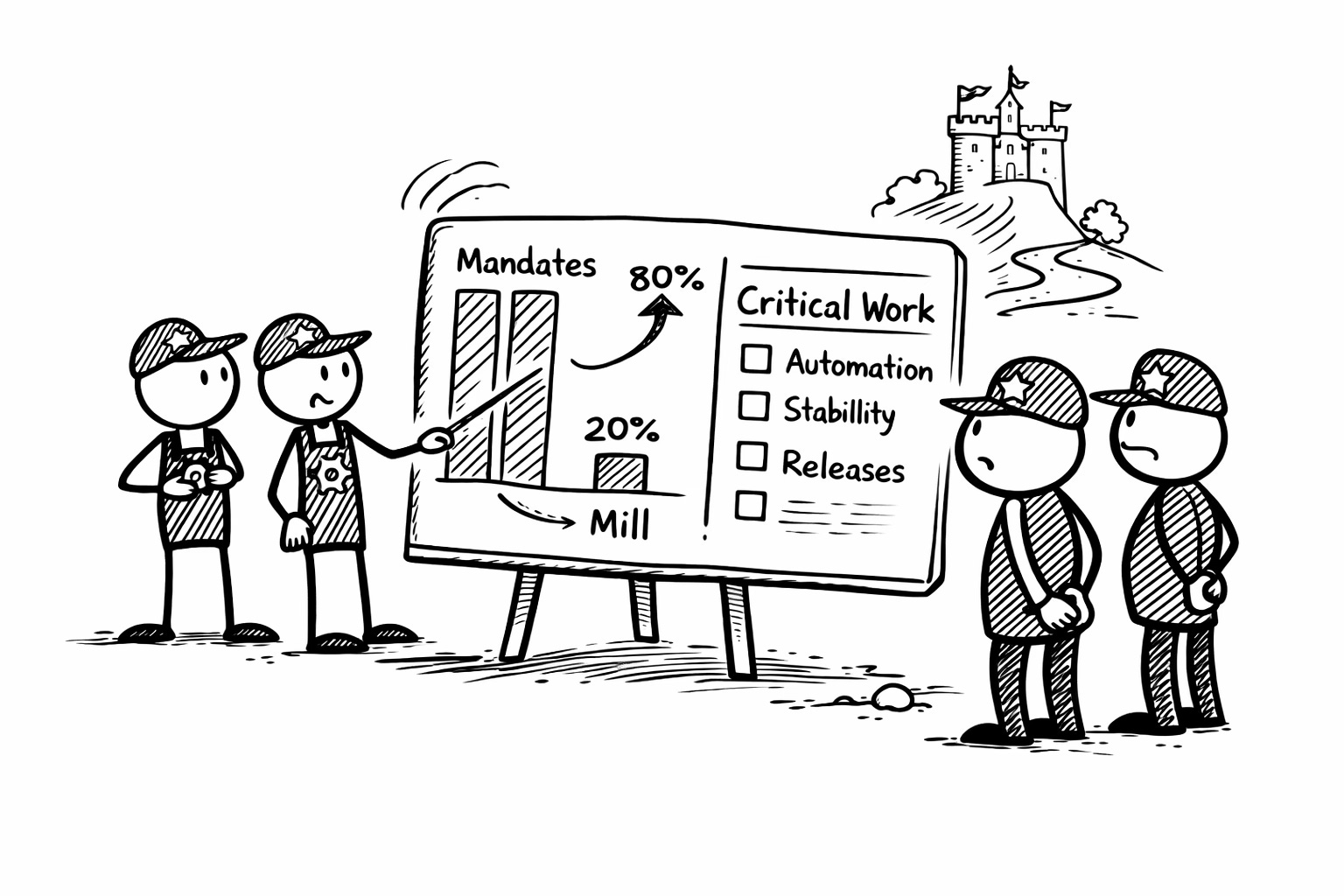
Illustration generated using AI image tools, prompted and directed by the author.
In that picture, I’d hope a pattern would emerge on its own. A large portion of the team’s energy spent advancing goals outside their own domain. A much smaller remainder left to carry the foundational work—work everyone agrees is critical, yet never quite urgent enough to protect.
At that point, the conversation wouldn’t need persuasion. The constraints would speak for themselves.
If the goal were truly to improve reliability, automation, and delivery cadence, the implication would be unavoidable: the team’s time would need to be protected. Not indefinitely. Not in isolation. But long enough to do the very work they had already identified as necessary.
I imagine that conversation would go more smoothly—not because anyone suddenly changed their values, but because the trade-offs would finally be explicit. Visibility has a way of neutralizing blame.
That doesn’t mean the story would end cleanly.
Leadership, in my experience, is skilled at finding narrow interpretations of broad truths. Even when the problem becomes visible, the response is often a partial adjustment—a compromise that changes just enough to feel like progress, while leaving familiar patterns intact.
If nothing else, though, I think the lesson would remain:
When priorities collide, clarity matters more than compliance.
And when explanations fail, showing the system as it truly operates can change the conversation in ways words never will.
Whether that lesson comes from observation, experience, or imagination, I’ll leave open to interpretation. 🙄