Hire Like a Founder
Applying the founder’s mentality to recruit self-aware, creative people who act like owners of the mission.
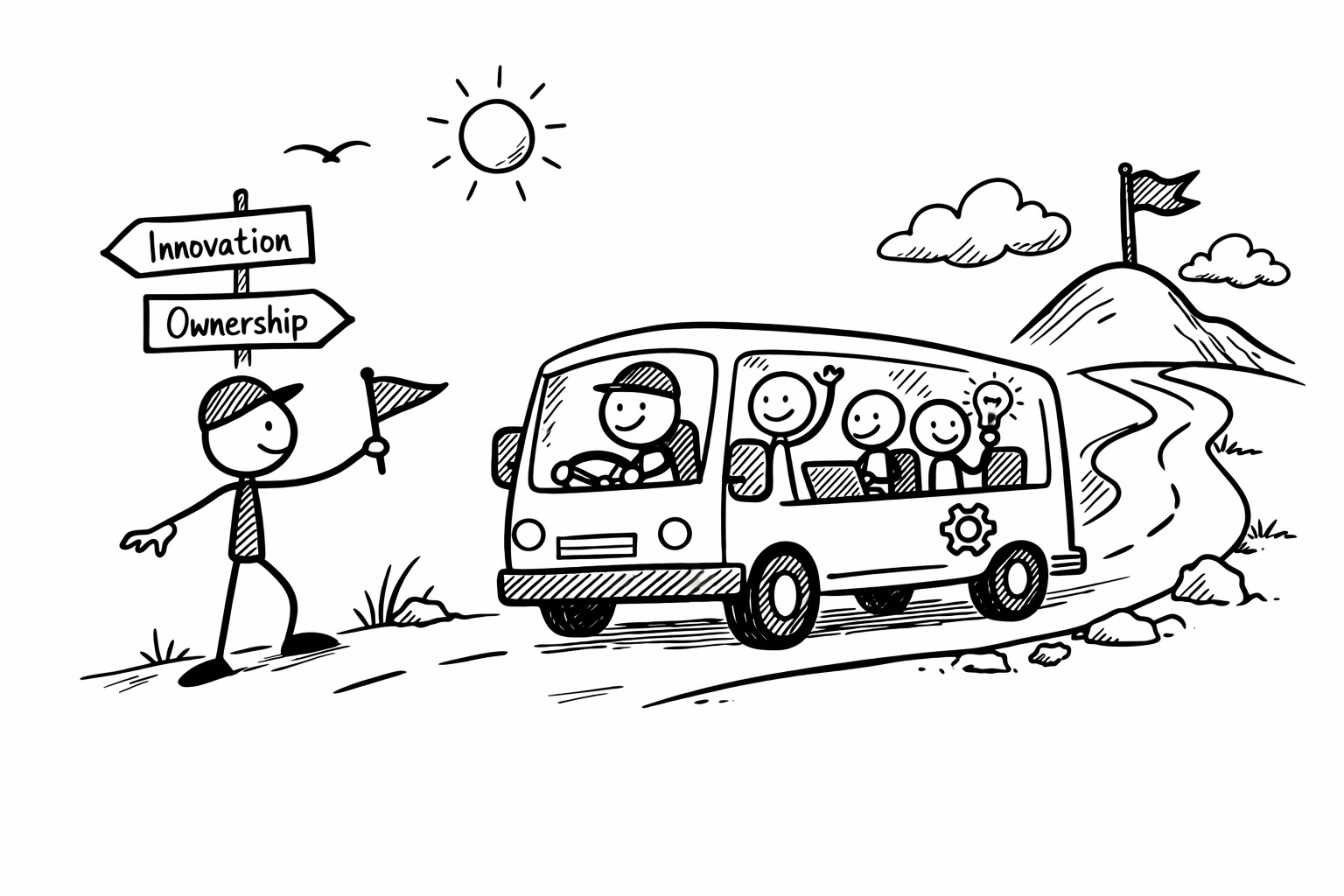
Illustration generated using AI image tools, prompted and directed by the author.
What I actually listen for in interviews (and why I rarely start with technical questions)
Below the paywall, I share the kinds of questions I’ve collected over years of interviewing—questions that help me understand how someone thinks, reflects, creates, struggles, and grows. These aren’t trick questions or gotchas. They’re conversation starters I use to explore character, curiosity, and what I think of as a founder’s mentality.
If you’re a hiring manager, this section may help you design interviews that surface the human signals résumés never show.
If you’re a candidate, it may give you insight into the kinds of conversations some managers are actually hoping to have—but rarely ask for directly.
I’ve been working for about 18 months with a team that had already been together for quite some time before I joined. When I step into situations like this—as the “new guy”—I’m intentional about how I begin. For the first few months, I focus on learning how everyone operates: what processes are in place, what the team norms look like, how decisions are made, and how conflict is handled. Those early observations give me a sense of how mature the team is and how well people actually work together.
Only after I’ve had time to listen and observe do I start making suggestions. I do this carefully, testing whether my experience can help close gaps I may have noticed or gently push the team just outside its comfort zone. To me, that’s part of the responsibility that comes with being a manager who genuinely cares—not just about outcomes, but about how the team functions as a system. Most of my suggestions tend to focus on process: saving a few minutes here, an hour there, or even a full day, so people spend less time wrestling with systems and more time doing creative, meaningful work. That’s always been my primary motivation.
One reality of joining a small, stable team is that unless someone leaves, opportunities to bring in new people are rare. There’s often little room to introduce fresh perspectives or diversify how the team thinks. That had largely been the case here—until recently. Due to a departure, an opportunity finally opened for me to start interviewing and hiring someone new to join the team.
Because I’ve been around for a while and have had the privilege of working with many people, I carry a mental list with me—my top five or ten engineers I’d hire in a heartbeat. When the environment and the opportunity align with someone’s aspirations, it’s natural for me to reach out and explore whether there’s mutual interest. Sometimes there is. Sometimes there isn’t—and that’s completely fine. Often, it simply means that person is happy and well-placed where they are.
Over time, I’ve learned to be clear about what I can and cannot control. Situations change. Timing shifts. Trying to force outcomes where I have no leverage usually leads to frustration and poor decisions. What individuals want for their careers is entirely up to them. My role begins only when a few things align—especially when someone is comfortable with uncertainty and doesn’t need every detail fully mapped out before considering an opportunity.
Recently, I spoke with someone about the opening on my team. What could have been a traditional interview turned into something closer to a conversation—a chance for both of us to decide whether this was worth investing our time and energy in. At one point, this person asked me a question I don’t hear very often: What kind of manager are you?
They explained that creativity—“coloring outside the lines”—was important to them. They wanted to know whether I expected strict adherence to processes or whether I was comfortable with deviation from a plan. They described how, instead of delivering exactly what was asked, they sometimes preferred to come back with a tool or a process that could ultimately solve the problem more effectively. It was a great question—and one I wish more candidates would ask.
I gave them the short answer first: yes, I’m comfortable meeting people halfway, and no, I don’t expect rigid obedience to lines drawn on paper. What I care most about is creativity and innovation. That said, accountability still matters. Being creative doesn’t absolve someone from delivering results. The balance I look for is someone who can innovate anddemonstrate that their ideas solve real problems.
As we talked, I also acknowledged something important: while I may operate this way as a manager, the broader environment doesn’t always share the same priorities. When asked how I rank mine, I explained that my priorities are, in order: the individual, the project, the organization, and then the company. Saying that out loud gave me pause. It forced me to reflect on where I truly belong in an organization.
I can easily understand how, at higher levels, leaders must prioritize organizational outcomes, revenue, and long-term viability. That doesn’t make their approach wrong—it simply reflects what the role demands. For me, however, it became clear that the level where I feel most aligned is one where I can care deeply about individuals first and support projects second.
That realization has shaped my hiring philosophy since I stepped down from a director role several years ago and was given the opportunity to build a team from scratch. My approach is simple: I hire drivers, not passengers.
If you imagine the team as a bus, I want people who can help drive it—not just sit on it. That doesn’t mean everyone must do everything all the time, but everyone should be willing and capable of stepping into different roles when needed. I look for what I often call a founder’s mentality—people who aren’t just there to check boxes, but who care deeply about what we’re building.
That’s why I often reference Ernest Shackleton’s Antarctic expedition when talking about hiring. His recruitment ad made no promises of comfort or glory. It was honest about risk, hardship, and uncertainty. That honesty wasn’t a deterrent—it was a filter. It attracted exactly the kind of people he needed.
I try to do the same. I want people who choose the team because they believe in the work, not just because of a paycheck. Compensation matters, of course—but what sustains a team over time is commitment, ownership, and the instinct to do the right thing even when no one is watching.
Over the years, I’ve interviewed many people, and there are a few who have stayed with me—not because of polished résumés, but because of what they revealed about themselves.
I once interviewed someone who initially followed the standard script—answering questions about where they saw themselves in five years, why they wanted to join the company, and why they had left their previous role. All reasonable answers. But later in the conversation, when we moved into more personal territory, something changed.
They shared—first hesitantly, then with growing conviction—that they had sold nearly everything they owned and invested every last dollar into attending a software engineering bootcamp. They saw it as their only real chance to change the trajectory of their life and pursue a long-held goal. That level of risk, commitment, and self-belief is hard to ignore. You can teach people how to code. It’s much harder to teach that kind of grit. I strongly recommended that this person be hired. I wasn’t hiring for my own team at the time, but if it had been my decision alone, I wouldn’t have hesitated.
In another case, we interviewed a woman returning to the industry after several years away, raising her daughter as a single mother. Throughout the interview, you could sense her uncertainty. She was careful with her words, hesitant to share strong opinions, and clearly worried that her time away—and her responsibilities as a parent—would count against her. Beneath that insecurity, though, was a deep passion for software engineering and a determination to reclaim her place in the field. I was in a position to recommend her hire, and she joined the company. She’s still there today—and doing exceptionally well.
I also remember interviewing someone who was working for a cable company—climbing poles, crawling through brush, attics, and crawl spaces to install internet lines. What stood out immediately was a strong “can-do” attitude. They had completed a bootcamp and weren’t asking for shortcuts—just an opportunity to prove themselves. I made them an offer, and they didn’t just meet expectations; they exceeded them.
There were also consultants I worked with—people whose paychecks came from a different company, but whom I treated no differently from full-time teammates. They were included in planning, decision-making, and ownership. When their contracts were terminated overnight due to decisions far above my head, the loss hit us hard. These were people deeply committed to the team’s success. I told them that if I ever had the chance, I’d bring them back.
Time passed. Non-competes expired. Circumstances aligned. When I finally had the opportunity, I brought them back immediately—no formal interviews needed. Their reputation had already been earned. Loyalty and follow-through like that strengthen a team in ways no résumé can capture.
One final example still stands out most vividly. Years ago, I worked with someone who had slowly faded into the background. They had stopped believing in themselves, fallen behind technically, and become the subject of lowered expectations. Eventually, we had an honest, difficult conversation—one that required trust on both sides.
They acknowledged that they no longer wanted to pursue a deeply technical path. What they wanted was to move into people management. Together, we built a plan—training, mentorship, gradual exposure to leadership responsibilities. They followed through on every step. Today, that person is a director, recognized as a leader people genuinely want to follow.
In all of these cases, I may have helped open a door—but I didn’t walk anyone through it. That part was always theirs.
When hiring works well, it isn’t about persuasion. It’s about alignment—between people, values, timing, and opportunity. When those truths line up, the right decisions tend to make themselves.
Listening for the Human Signals
I’ve never believed that the most important part of an interview is proving how much someone knows. Skills can be learned. Tools change. What lasts—and what ultimately determines whether a team thrives—are the human qualities people bring with them.
The questions that follow are ones I’ve collected over many years. Some were inspired by books I’ve read, others by conversations I’ve had, and many by interviews that stuck with me long after they ended. I don’t claim ownership over them, and I don’t ask them as a rigid script. I pick and choose, follow the conversation where it naturally goes, and listen far more than I talk.
These questions are designed to surface things that don’t show up on résumés: self-awareness, accountability, creativity, empathy, resilience, and how someone behaves when no one is watching. I use them to understand whether someone has what I think of as a founder’s mentality—a sense of ownership, curiosity, and responsibility that goes beyond a job description.
If you’re a hiring manager, my hope is that these questions help you create interviews that feel more like meaningful conversations and less like interrogations. If you’re a candidate, reading them may give you insight into what values-driven leaders listen for—and how you might better articulate who you are, not just what you’ve done.
There are no right answers here. What matters is honesty, reflection, and the willingness to think out loud.
Self-Awareness & Identity
- If the people who know you best were describing you—family, close friends, someone who genuinely likes you—what three words do you think they’d choose?
- What personal qualities are you most proud of, and why those?
- When you look back on something you’re genuinely proud of accomplishing, what parts of you made that possible?
- What kind of positive feedback do you hear repeatedly from managers or peers?
- When your inner critic shows up, what does it tend to accuse you of?
Growth, Aspiration & Reflection
- If you could instantly gain a few traits or abilities you don’t yet have, what would you hope for?
- What are a few things that get under your skin more than they probably should?
- What feedback have you received—more than once—about how you could be more effective?
- When you eventually leave your current role, what do you hope people remember about your impact?
- Looking five years ahead, what would success actually look like to you—not in titles, but in outcomes?
Judgment, Prioritization & Ownership
- Imagine you start the day buried under thousands of emails, but realistically can only respond to a fraction. How do you decide what matters?
- Tell me about a time you solved a problem by reframing it rather than attacking it head-on.
- Can you describe a situation where you created a tool or process that reduced friction for others?
- When someone brought you an unconventional idea, how did you respond? What did you do next?
- What’s the most creative thing you’ve built in your current role—and how was it received?
Inclusion, Empathy & Courage
- What do diversity, equity, and inclusion actually mean to you—not as concepts, but in practice?
- What do you find most challenging about working in diverse environments?
- How do you try to understand perspectives that are very different from your own?
- If you witnessed behavior that was culturally insensitive, sexist, racist, or exclusionary, how would you respond?
- How do you help the people you work with feel a sense of belonging and fairness in day-to-day interactions?
- Can you share a moment when you actively advocated for inclusion, even when it wasn’t easy?
I don’t ask these questions to score answers. I ask them to understand how someone navigates uncertainty, responsibility, and other people. Founder-minded teammates tend to reveal themselves not through perfection, but through reflection—how they talk about mistakes, growth, discomfort, and ownership.
You can teach tools.
You can teach systems.
It’s much harder to teach curiosity, courage, empathy, and accountability.
That’s what I’m listening for.