Built To Last
A personal reflection on building software that lasts, from early programming days to creating open-source tools still actively used over a decade later. A story about the commitment to quality, long-term thinking, and creating lasting value through software craftsmanship.
On learning by building, lowering the bar to entry, and the quiet legacy of useful work
 Built To Last
From the very beginning, when I first got my first computer—around the age of 11 or 12—I felt inclined toward building things that were helpful and useful to others. Like many of my friends who eventually went into the computer industry and became software engineers, it all started with games. The thrill of writing your own game—something other people could use and that you could show off to your friends—was incredibly exciting to me.
But over time, that excitement evolved into something more benign, more altruistic: a desire to build things that could actually help people. I remember someone close to my family who was running a restaurant in the mid-to-late 1980s. With my very modest understanding of programming languages—and an even simpler, far less efficient computer—I managed to create an interactive menu where a pixelated waitress would prompt you for what you wanted to order. That small project stuck with me.
After that, my aspirations shifted. For a while, I wanted to be an author. Then I wanted to be a private detective, largely influenced by Conan Doyle and the Sherlock Holmes adventures. Eventually, I wanted to be a scientist. Software engineering, as a career aspiration, was pushed to the back burner. That remained the case for many years—until it eventually became what I do today.
Recently, I was genuinely and pleasantly surprised when someone pointed out statistics related to one of my projects. A Python library I created back in 2014 for generating random data used in automated testing—originally meant to support another project I had built in 2012—is still very much alive. That library started primarily as a learning exercise for me: I wanted to understand what it would take to build a clean, Pythonic library for automated testing. Even though other tools already existed, the real goal was to sharpen my skills and learn by doing.
That library was adopted as the official tool for the 2012 project and, to this day, it’s still being used. That surprised me—though perhaps it shouldn’t have. I’ve noticed a pattern over the years: every project I work on or spend time creating is something I build to last. From the very beginning, I try to think about how to make a tool useful and how to lower the barrier to entry so people have no excuse not to try it out.
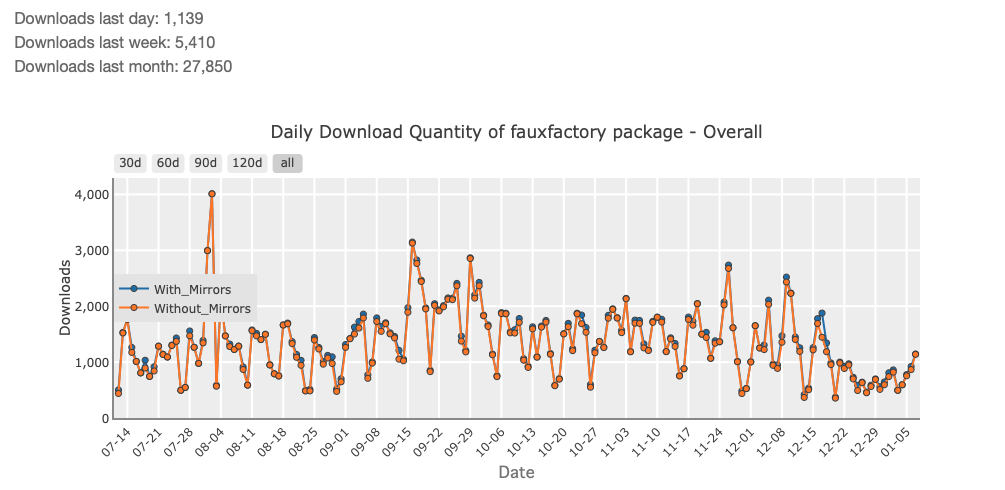 Downloads per month
Today, that Python library generates over 27,000 unique downloads per month–a number that’s been fairly consistent since its early days. The other surprise was the original project from 2012 itself. It’s still in use, has accumulated over 13,400 commits, and I was completely responsible for its original creation and architecture. I worked on it directly for about a year to a year and a half before transitioning into people management, at which point my available time dwindled. From then on, I served mostly as a maintainer and long-term steward, while hiring many people over the years who contributed meaningfully to the project.
Like anything created many years ago, it’s easy to look back and smile—or cringe—at some of the decisions I made. But the fact that the project is still actively used and has amassed over 13,400 commits says something about the kind of legacy I try to build with my work.
What’s funny is that the last time I checked the statistics, even after more than ten years, I was still the number-one committer—the person who contributed the most code overall—even though I had only worked on it directly for a relatively short time. GitHub can no longer generate that statistic easily because of the sheer number of commits, but if you take my word for it, it’s still true.
There are many other projects out there, of course, but this was a meaningful reminder of the kind of work I gravitate toward: the level of care, effort, and long-term commitment I bring to the things I build. I believe those who have worked with me would vouch for that.