The Role I Wanted—and the One I Left
4
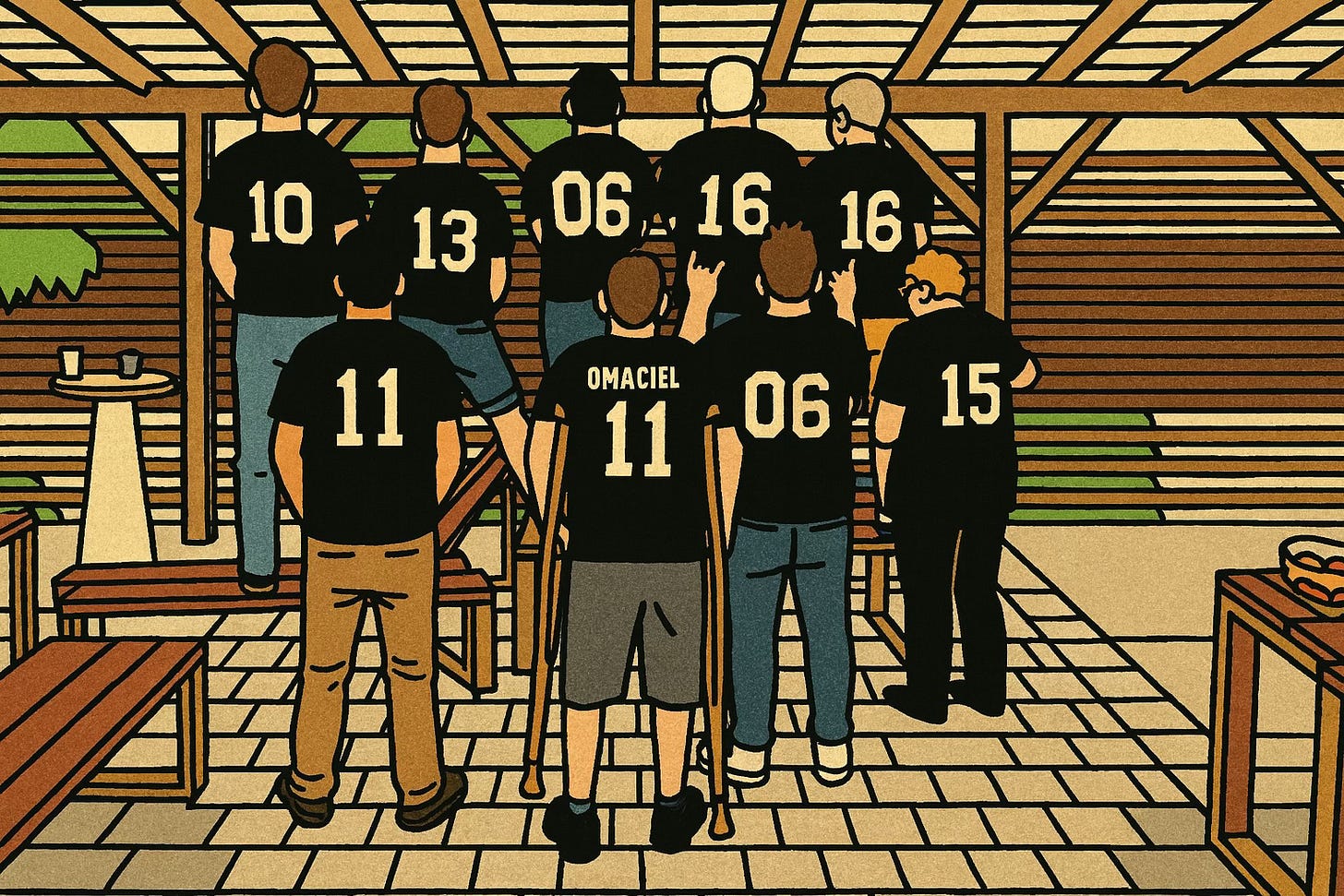 This is a cartoonized rendering of a real photograph. All names and identifying details on the shirts have been removed to respect the privacy of the individuals involved.
It was July 16th, 2019. In the photo above, I’m standing with the quality engineering managers who reported to me at the time. Together, we represented what I believed—earnestly—to be the future of quality engineering at the company.
That may sound ambitious, even a little arrogant in retrospect, but it reflects how I felt then. I had big goals. I believed deeply in building a better engineering culture—one rooted in trust, craft, curiosity, and care for the people doing the work. I had worked hard for years to get to that moment, and I was ready to prove that we could do things differently.
A few months earlier, in February 2019, I had stepped into what I thought was the culmination of my career up to that point: Director of Quality Engineering for a newly formed organization responsible for six major products. That organization no longer exists, but most of the products still do. The role came with a larger scope, my own budget, and responsibility for managing a group of experienced people managers. For the first time, I had real autonomy—and the means to act on ideas I had been carrying for years.
That July, I used that autonomy to bring the entire leadership team together in the Czech Republic for a week of planning. The goal wasn’t just alignment on priorities; it was alignment on values. I wanted us to know each other as people, not just names in org charts. I wanted us to build something together.
On paper, I should have been happy. I thought I was.
But the path to that role was already more complicated than I had expected.
When I was offered the directorship, I learned—indirectly, from a reliable source—that the role had first been offered to a peer of mine while my manager was traveling with him. He declined, saying he wasn’t ready for the responsibility. By the time the offer came to me, I knew I wasn’t the first choice.
That knowledge stung more than I expected. I had worked closely with that manager for years and had been instrumental in many of the successes attributed to his organization. I had supported difficult decisions, backed unpopular initiatives, and carried work that wasn’t always visible. I assumed—wrongly—that this made me an obvious choice when the next opportunity arose.
My ego took the hit hard.
I seriously considered declining the role. I explored other positions within the company, partly to regain a sense of agency, partly to prove—to myself more than anyone—that I didn’t need to accept being second choice. But after weeks of wrestling with it, I realized that the directorship still represented the best chance to do the work I cared most about. It would give me the freedom to try.
So I accepted. Not triumphantly, but deliberately. I set my pride aside and focused on the opportunity ahead.
The Czech Republic offsite was my attempt to set a different tone from day one. I even had team T-shirts made, styled like sports jerseys, with the year each person joined the company on the back. I wanted us to feel like a team.
We spent days working through a shared vision and mission—not something handed down, but something we built together. I challenged the group to think beyond the usual metaphors. If the “moonshot” was the standard aspiration, I argued we needed to go to Mars. Bigger thinking. Longer horizons.
We started the week with a mindfulness session. That, too, was intentional. I wanted openness. A growth mindset. Trust.
And that’s where the cracks began to show.
It became clear—quickly—that trust was fragile. Some relationships were already strained. Some people were open to change; others were deeply invested in preserving how things had always worked. Throughout the week, individuals approached me asking to be moved away from certain peers, or to leave their reporting lines altogether. One request, in particular, consumed days of conversation—only for the person to reverse course without telling me once a more attractive opportunity appeared.
It wasn’t dramatic. It was quiet. Procedural. Political.
That moment shifted something for me. Not because it was egregious, but because it revealed priorities that didn’t align with the vision we had just spent a week articulating together. Over time, similar moments accumulated, each one small enough to rationalize, but collectively difficult to ignore.
Still, I left that week hopeful. We had barbecues. Music. A Mario Kart tournament. Laughter. I genuinely believed that with time, patience, and consistency, I could bring this group together.
What followed were two of the hardest years of my professional life.
The optimism gave way to resistance. Change was tolerated in theory but discouraged in practice. Decisions were second-guessed quietly. Trust eroded. Politics increasingly overshadowed purpose. Some of the people I had invested in the most became obstacles rather than partners.
The toll was real—mentally and physically. I spent long stretches questioning myself, wondering whether persistence was courage or stubbornness. After months of agonizing reflection, I made a decision that scared me more than taking the role in the first place: I stepped down.
There was no safety net. No guaranteed landing. Walking away from a director role felt irrational from the outside, but necessary on the inside.
Staying would have meant continuing to compromise parts of myself I wasn’t willing to lose.
Looking for another role internally only exposed more of what I had sensed all along. The environment wasn’t hostile—but it wasn’t open to deviation either. The higher I had climbed, the more the work shifted away from people and toward power, preservation, and caution. Anything that challenged the status quo—even thoughtfully—was treated as a risk to be neutralized.
In March 2021, I left the role and started over at a lower level, with a clean slate.
I didn’t know then that this decision would eventually lead me to build what became one of the most meaningful teams of my career. That story is for another day. It has its own complexities—its own highs and lows—but it remains a bright chapter.
Becoming a director taught me something I hadn’t expected: leadership roles don’t automatically grant the freedom to change systems. Sometimes, they reveal the limits of the system itself.
And knowing when to step away can be as important as knowing when to step up.